
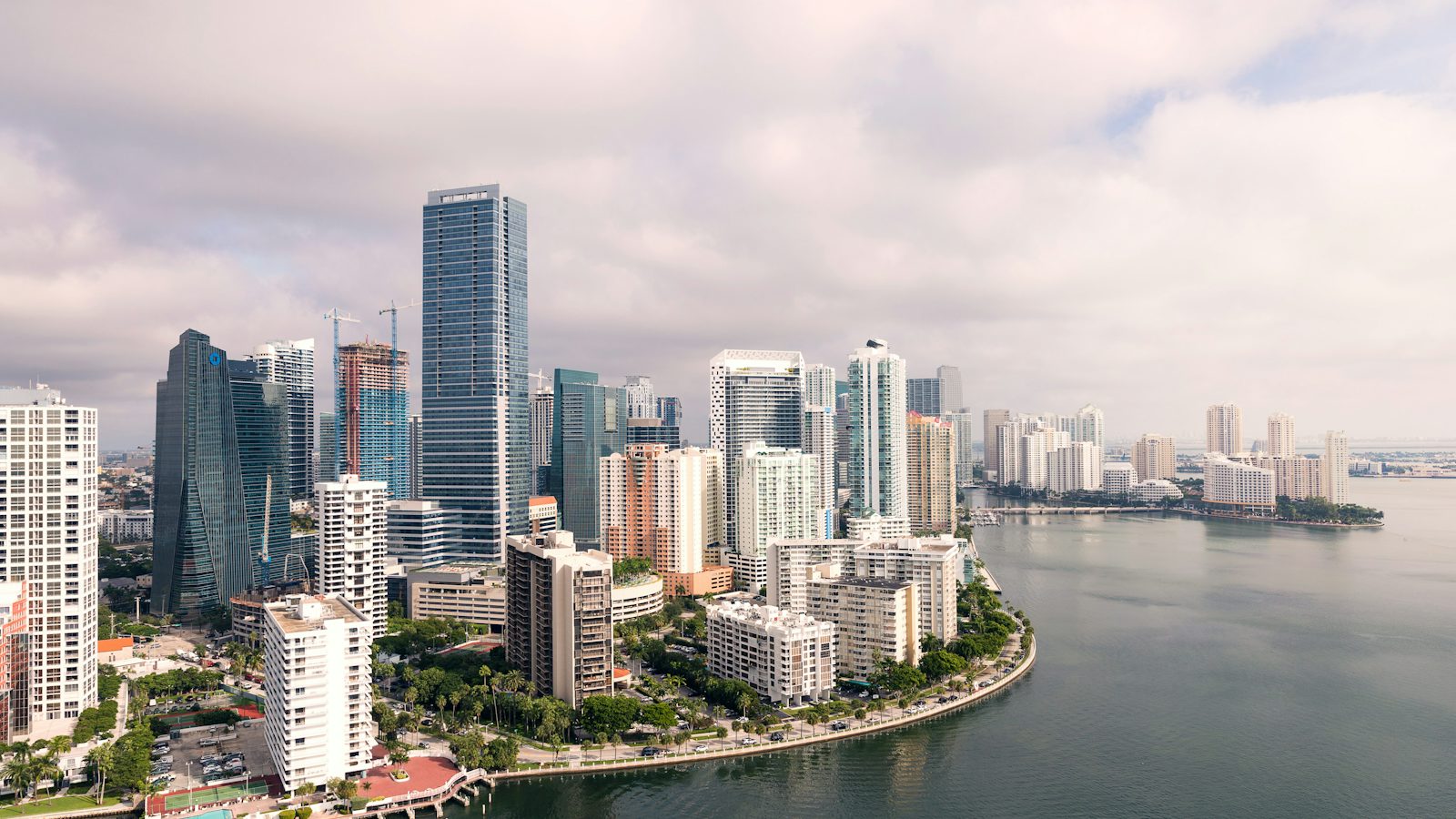
Miami International (MIA) has nonstop flights to around 200 destinations, and more than half of them are outside the United States. That mix is what sets Miami apart from the other large US hubs. Its Caribbean and South American lists are the longest of any US airport, and its list of US cities is shorter than Atlanta’s or Charlotte’s.
So for a group trip from different cities, a family reunion or a company offsite that includes people in Latin America or the Caribbean, Miami is often the city everyone reaches without connecting. For a group entirely inside the US, it is a longer flight for most of the country than a central hub.
The numbers behind MIA
MIA has nonstop flights to around 200 destinations over the next twelve months, spread over around 65 countries. Its list splits into around 90 US cities and around 110 abroad. Figures are from Midway’s route data as of October 2026, counted for MIA alone and rounded to the nearest 5.
The Caribbean is the largest part of the foreign list. MIA has nonstops to more Caribbean destinations than any other US airport, close to twice as many as Newark or JFK. Sixteen of its destinations have no nonstop from any other US airport in Midway’s data, Puerto Rico included. Five of them are Cuban cities outside Havana (Holguín, Santa Clara, Camagüey, Santiago de Cuba and Varadero), and four are in South America (Maracaibo, Manaus, Santa Cruz in Bolivia and Montevideo).
South America adds around 20 cities, from Bogotá and Medellín to Lima, Santiago, São Paulo and Buenos Aires. Mexico is the weak spot, with seven Mexican destinations against around 25 from Houston and around 30 from Dallas-Fort Worth. Europe and the Middle East are covered too, with London, Madrid, Paris, Frankfurt and Rome all year, plus Doha, Dubai and Tel Aviv. Nothing in the data goes to Asia or Oceania, so a group with someone in Tokyo or Sydney will connect somewhere.
American Airlines flies to more than four in five of MIA’s destinations, and for close to half of them it is the only airline. No other carrier serves even one in ten. That puts Miami closer to Atlanta, where Delta serves almost every route, than to Los Angeles, where no airline reaches half the list. For a group with mixed airline loyalties, it means someone flying JetBlue or Allegiant will usually find more nonstops into Fort Lauderdale than into MIA.
See which destinations your group can reach from Miami. Enter everyone’s departure airports and Midway lists the cities all of them reach nonstop. It counts MIA alone for Miami, so run the search again with FLL to see what Fort Lauderdale adds.
Routes that change with the season
About a fifth of MIA’s destinations do not run in every month of the next twelve, and the map is larger in winter than in summer. January has around 195 destinations with a scheduled nonstop, September around 165. Northern US cities such as Albany, Syracuse, Madison and Cedar Rapids run roughly from November to April.
Several European routes follow the same winter pattern. Copenhagen, Dublin and Munich run from October to March in the current schedules, and Helsinki from November to April. So a winter meeting between Europe and the US has a few more European cities to choose from in Miami than a summer one. Midway’s month filter shows the destinations that run in the month you pick, and it cannot tell you whether an airline will add or drop a route after the schedules it has.
Miami or Fort Lauderdale
Fort Lauderdale-Hollywood (FLL) is about 20 miles north of MIA and reaches around 155 destinations. Around 40 of them have no nonstop from MIA. Most are smaller US cities, many of them on Allegiant, such as Allentown, Flint and Rockford, plus Calgary, Halifax, Québec City and Winnipeg in Canada and a few Bahamian islands. Counted together, the two airports reach around 245 destinations.
The carriers differ more than the reach. JetBlue is the largest airline at FLL, followed by Allegiant and Southwest, and American has only a handful of routes there. The US ranking counts Miami and Fort Lauderdale separately, and Midway’s search does the same.
MIA
West of downtown, closest to Brickell, Little Havana, Coral Gables and Wynwood, with Miami Beach across the causeways. It is the default for anyone flying from Latin America, Europe or the Middle East.
Fort Lauderdale (FLL)
Closest to Fort Lauderdale, Hollywood and the beaches north of Miami. It suits a group staying in Broward County, or one where several people fly JetBlue, Allegiant or Southwest. Tri-Rail commuter trains link both airports, with a short transfer at each end.
In most cases the simpler order is to choose where the group will stay, check MIA for everyone, and look at FLL only for the people MIA leaves out.
A worked example
Take a group flying from Medellín, Denver and London Heathrow. They share eight destinations in Midway’s data: Cancún, Houston, Miami, Montego Bay, Mexico City, New York JFK, Orlando and San José in Costa Rica. Miami, Houston, Mexico City, New York and Montego Bay have all three routes in every month, while Cancún and Orlando each depend on a route that runs seven months and San José on a Denver route that runs eleven.
Measured by the longest leg, New York JFK is the shorter option: London to JFK is about 7h50, against about 9h40 from London to Miami. Miami is closer for the Medellín traveller and warmer in winter, and the group has to decide which of those matters more.
See also: Chicago–Miami meeting points and San Francisco–Miami, or browse the full city-pair meeting points hub for every pair.
Flight times from MIA
Shortest scheduled time from MIA in Midway’s data:
| To | Flight time |
|---|---|
| Havana (HAV) | 1h 16m |
| Atlanta (ATL) | 2h 00m |
| San Juan (SJU) | 2h 38m |
| New York (JFK) | 2h 59m |
| Dallas-Fort Worth (DFW) | 3h 14m |
| Chicago (ORD) | 3h 23m |
| Mexico City (MEX) | 3h 24m |
| Bogotá (BOG) | 3h 45m |
| Denver (DEN) | 4h 22m |
| Los Angeles (LAX) | 5h 27m |
| Lima (LIM) | 5h 35m |
| Madrid (MAD) | 8h 15m |
| São Paulo (GRU) | 8h 20m |
| London (LHR) | 8h 45m |
Times are the shortest monthly schedule over the next twelve months. Flights toward Miami take a different time, mostly because of prevailing winds.
Planning a group meeting in Miami
Getting around. Metrorail’s Orange Line runs from the airport to downtown, which covers Brickell and the city centre. Miami Beach has no rail link, so a group staying there will depend on cars, rideshare or buses, and the causeways back up at busy times.
Seasons. Winter and spring are the high season, which is also when the route map is largest. Hurricane season runs from June to November, and summer is hot and humid with frequent afternoon storms. Art Basel Miami Beach in early December usually fills hotels on the beach.
Budget. Miami is rarely a cheap meeting city in winter. Beach hotels sit at the top of the range in the high season, and rates usually drop in summer and early autumn, which is also hurricane season. Staying in Fort Lauderdale often costs less, at the price of a longer drive.
Who meets in Miami
Groups spanning the US and Latin America. The strongest case, when the Latin American side is in the Caribbean, Colombia, Peru, Brazil or Argentina. The affordable family destinations in the Americas guide covers options on both continents. For a group that includes Mexico, Houston or Dallas-Fort Worth usually works better.
Transatlantic groups in winter. Miami has more European routes in winter than in summer, and the weather is the draw. For a summer meeting, or when the European half matters most, New York is usually closer. The US–Europe meeting destinations guide compares the options.
Groups inside the US. It works for the East Coast and the South. For a group spread across the whole country, the West Coast half flies five and a half hours or more each way, and a central city such as Dallas-Fort Worth is probably fairer.
The route count settles reach when the group includes the Caribbean or South America. It does not settle the airline, so check MIA for everyone first, then try Fort Lauderdale for anyone who flies JetBlue or Allegiant.