
Dallas-Fort Worth is second among US airports by route count, behind Chicago O’Hare, with around 270 nonstop destinations spread across one of the largest airports in the country by physical footprint. American Airlines treats DFW the way Delta treats ATL, as a fortress hub that anchors its entire route network, and the city has less of a tourism brand than its connectivity would suggest.
For groups whose members are scattered across multiple cities, DFW is often the answer on the math: cheaper than the coastal cities, more connected than the regional ones, and central enough that flight times stay reasonable from both coasts.
American’s largest hub
American Airlines runs about 900 daily flights out of DFW. The international reach is among the deepest in the US: Tokyo, Sydney, Madrid, London, Frankfurt, Doha, plus saturation coverage of Mexico and Latin America. The domestic schedule fills in every secondary market American serves: Wichita, Tulsa, Knoxville, Boise, Spokane, Pensacola. If a midsize US city has any commercial air service at all, there’s a strong chance it’s connected to DFW.
The limitation is carrier concentration. American operates around 80% of DFW’s daily flights, which means Southwest loyalists need to fly into Dallas Love Field (DAL) instead, a separate, smaller airport about 20 minutes north. For most groups planning a one-time trip, DFW’s depth wins. For Southwest-heavy groups, DAL’s roughly 70 nonstop destinations cover most needs.
For groups split coast-to-coast, the appeal is geography plus schedule. DFW shows up as a common nonstop option for nearly any combination of East Coast and West Coast cities, with the added benefit that flight times are roughly balanced: three hours from LA, three from New York, two from Chicago.
Check Dallas-Fort Worth nonstops for your group.
Two cities, one trip
Dallas and Fort Worth are separate cities with their own personalities, about 35 miles apart, with the airport sitting between them.
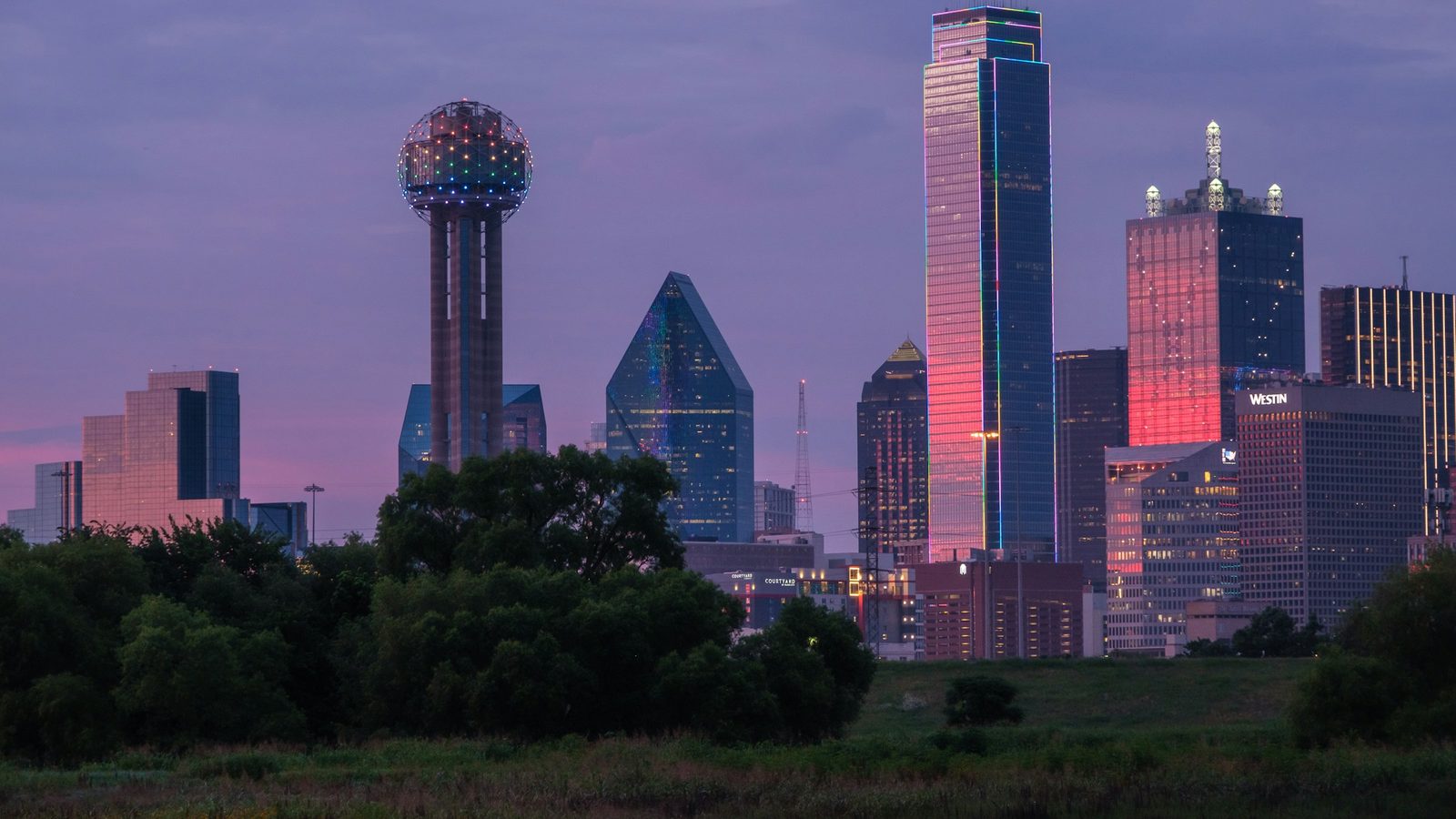
Dallas is the larger, glossier of the two. Uptown is the dense walkable district with bars and restaurants. Bishop Arts in Oak Cliff is the indie food and shopping neighborhood, and feels like a small town inside the metro. Deep Ellum is the music and nightlife district. Knox-Henderson is where the brunch crowd ends up. The Dallas Museum of Art and Nasher Sculpture Center anchor a credible cultural district.
Fort Worth keeps a different character. The Stockyards is a working historical district with twice-daily cattle drives down Exchange Avenue, touristy and unlike anything in Dallas. The Cultural District has the Kimbell, the Modern, and the Amon Carter, three major museums within walking distance of each other. Sundance Square downtown is compact and walkable. A long weekend with a morning in Fort Worth and an evening in Dallas covers both.
Food. BBQ everywhere (Pecan Lodge in Deep Ellum, Heim in Fort Worth, Cattleack out by the airport), Tex-Mex on every corner, plus a serious fine dining scene that pulls from both coasts.
Take a group flying from New York, LA, and Seattle. Dallas-Fort Worth shows up in the overlap with a handful of other options:
See also: Detroit-Dallas meeting points and Charlotte-LA, both of which feature Dallas prominently in the results, or browse the full city-pair meeting points hub for every pair.
Budget and logistics
DFW is cheaper than the coastal alternatives. Hotels in Uptown run $160-240/night for solid 4-star options outside of convention weeks; Downtown Dallas and Fort Worth’s Sundance Square run $130-200.
Getting from the airport: DFW is enormous. The five terminals are connected by an internal Skylink train; allow extra time for transfers. To Dallas, DART rail’s Orange Line runs from the airport to downtown Dallas in about 50 minutes for $3, slow but cheap. Most groups skip it and rideshare ($45-60 to Uptown, depending on traffic). To Fort Worth, the TEXRail commuter line runs from Terminal B to downtown Fort Worth in 50 minutes for $2.50.
Flight times from major cities:
| From | Flight time |
|---|---|
| New York (JFK) | 3.5 hours |
| Los Angeles (LAX) | 3 hours |
| Chicago (ORD) | 2.5 hours |
| Atlanta (ATL) | 2 hours |
| Seattle (SEA) | 4 hours |
Best seasons: March through May, October through November. Summer is the trade-off: temperatures regularly clear 100F from June through August, and the dry heat doesn’t help as much as people claim. Winter is mild (50s F daytime) with the occasional ice storm that grounds flights.
Who meets in DFW
Family reunions. The scale and affordability work for large families. Plenty of group-friendly hotels, restaurants that can absorb a party of 15, and the connectivity that makes flying everyone in straightforward. Atlanta is the obvious comparison; DFW often wins on hotel cost and rarely loses on flight access.
Corporate offsites. DFW has the convention infrastructure of a top-five US business city. The airport-to-hotel logistics are clean (American has offsite-package partnerships with regional resorts), and for teams with members in non-coastal cities, the nonstop coverage is deep. Worth comparing against our distributed team offsite guide.
Friend trips. Less party-tourism than Nashville or Vegas, but a deep enough food and music scene to keep a long weekend interesting. The Dallas-Fort Worth axis gives groups two different cities to explore without leaving the metro.
Sports travel. The Cowboys, Rangers, Mavericks, and Stars all play within a 30-minute radius. For groups organized around a game or a tournament, DFW’s connectivity keeps the meet-up logistics cheap.
Most of DFW’s flights are American’s, so a group that includes Southwest flyers is planning around two airports 20 minutes apart. Put the hotel block where both DAL and DFW can reach it.