
Every other country in Southeast Asia has a nonstop to Singapore (SIN), and so do 8 of the 9 Indian airports in Midway’s route data, seven Australian airports, Hong Kong, Taipei, Seoul and Tokyo, in every month of the data. So a team spread across Asia and Australia can usually fly everyone in on a nonstop, and no flight from those offices takes more than about eight and a half hours. Offices in Europe can fly in too, at 11 to 14 hours. Only five US airports can.
Each count comes from Midway’s route data as of 2 November 2026. Changi’s own list covers October 2026 to September 2027 and holds around 165 destinations, all international. An office counts here when Singapore appears in its own airport’s list in at least one month, and flight times are from that list, into Singapore. Several of those lists, including Kuala Lumpur, Manila, Tokyo Narita, Melbourne and Munich, start in November 2026.
The Singapore city profile covers the network itself: Scoot against Singapore Airlines, the routes by region and getting from Changi to the city. This page covers what an offsite adds on top: which offices fly in, where the team meets, what hotels and activities cost, and which months to pick.
See whether Singapore is on the shared list for Sydney, Bengaluru, Hong Kong and Tokyo
Offices in Southeast and East Asia
Changi’s list reaches every other country in Southeast Asia, and the regional flights are short. Kuala Lumpur takes around 1h05 to 1h10 and Jakarta 1h45, each with seven airlines. Bangkok takes around 2h25 to 2h30, Ho Chi Minh City 2h00 to 2h20, Hanoi 3h30 to 3h35 and Manila 3h50 to 3h55. Penang, Phuket, Bali, Surabaya, Cebu and Da Nang also fly to Singapore all year.
Hong Kong takes around 4h00 to 4h05 and Taipei 4h30 to 4h55. Seoul Incheon has six airlines, at around 7h00, and Tokyo Haneda four, at around 7h05 to 7h35. Narita, Osaka Kansai, Nagoya, Fukuoka and Okinawa fly to Singapore all year too, but Sapporo only from December to February.
Thirty of the 43 Chinese airports in Midway’s data have a Singapore route. Shanghai Pudong has six airlines, at around 5h45 to 5h55, and Beijing has two airports with a route, both at around 6h15 to 6h35. Shenzhen and Guangzhou take around 4h05 to 4h10. Shanghai Hongqiao and Chengdu Shuangliu have none, so an office there flies from Pudong or Tianfu instead.
Offices in India, Australia and New Zealand
Bengaluru, Chennai, Delhi, Mumbai, Hyderabad, Kolkata, Kochi and Ahmedabad all fly to Singapore in every month. Pune is the one Indian airport in the data without a route. The flights take around 4h20 to 4h30 from Chennai, 4h50 to 4h55 from Bengaluru, 5h55 to 6h00 from Mumbai and 5h55 to 6h10 from Delhi. IndiGo and Singapore Airlines both fly from all six of the larger cities.
Sydney, Melbourne, Brisbane, Perth, Adelaide, Darwin and Cairns fly to Singapore all year. Perth takes around 5h25 to 5h35 and Darwin 4h45 to 4h50. From the east coast it is about eight hours: 7h50 to 8h10 from Melbourne, 8h00 to 8h20 from Brisbane and 8h05 to 8h25 from Sydney. Canberra, Hobart and the Gold Coast have no route, so an office there connects.
Auckland and Christchurch both have Air New Zealand and Singapore Airlines all year, at around 10h35 to 10h50. For a team with offices in eastern Australia, the city profile also compares Bali, which is closer to Melbourne.
See every city Sydney, Auckland, Bengaluru and Jakarta all reach nonstop
Offices in Europe, the Gulf and the Americas
Seventeen airports in Europe and Turkey fly to Singapore in every month of their data. London has Heathrow and Gatwick, plus Manchester, and Paris, Frankfurt, Munich, Amsterdam, Zurich, Rome, Milan, Brussels, Copenhagen, Barcelona and Istanbul are on the list too. Singapore Airlines flies all but three of them. Finnair has Helsinki, and Scoot has Athens and Vienna. Madrid, Berlin, Lisbon, Dublin and Stockholm have no route.
These flights are long. They take around 11h00 to 11h15 from Athens, 12h10 to 12h15 from Munich, 12h25 to 12h40 from Frankfurt, 12h40 to 12h50 from Paris and 13h20 to 13h45 from London Heathrow. Istanbul takes around 10h30 to 10h45. Bengaluru to Amsterdam takes around 10h05 to 10h35, as the Amsterdam profile shows, so a team mostly in Europe with one office in India is often better off meeting there.
Dubai, Doha and Abu Dhabi all fly to Singapore every month, at around 7h30 to 8h10. Johannesburg takes around 11h25 to 11h35 and Addis Ababa 9h40 to 10h00. Riyadh starts in March 2027.
Five US airports fly to Singapore all year: San Francisco, Los Angeles, Seattle, New York JFK and Newark. Singapore Airlines flies all five, and United also flies from San Francisco. Amsterdam has 22 US airports, as its profile shows. The flights take around 16h20 to 17h05 from Seattle, 16h25 to 17h25 from San Francisco and 17h00 to 17h40 from Los Angeles. From New York it is about 19 hours: 18h55 to 19h15 from JFK and 19h10 to 19h30 from Newark.
Vancouver has Air Canada from October 2026 to January 2027 only, and no other Canadian airport has a route. No airport in Mexico or South America does either. So an office in the Americas outside those five US cities connects, and the budget breakdown by flight access shows which lines that adds.
Longest flight into Singapore for five team spreads:
| Offices | Longest flight | From |
|---|---|---|
| Jakarta, Bangkok, Ho Chi Minh City, Manila | 3h50 to 3h55 | Manila |
| Bengaluru, Hong Kong, Tokyo Haneda, Sydney | 8h05 to 8h25 | Sydney |
| Delhi, Melbourne, Auckland | 10h35 to 10h50 | Auckland |
| London Heathrow, Bengaluru, Sydney | 13h20 to 13h45 | London |
| San Francisco, Bengaluru, Sydney | 16h25 to 17h25 | San Francisco |
These are flight times into Singapore from each office’s own list, over the months that list covers. The flight home can differ by an hour or more.
Months and seasons
Nearly all of the office routes on this page run in every month. The exceptions are Vancouver, October to January, Sapporo, December to February, and Riyadh, from March 2027. In China, Wuhan, Wuxi and Ningbo list their Singapore routes only until March 2027. Those may be winter timetables that later months will add to, so check before fixing the date. The city profile shows how Changi’s list changes month by month.
The Meteorological Service Singapore publishes 1991–2020 climate normals for the Changi climate station. The average daily high stays between 30.5°C (87°F) in December and 32.4°C (90°F) in April. December is the wettest month, at 331.9 mm, then November at 252.3 mm. February is the driest, at 105.1 mm. The Northeast Monsoon runs from December to early March and the Southwest Monsoon from June to September.
The Ministry of Manpower lists the 2027 public holidays. Chinese New Year falls on 6 and 7 February 2027, a weekend, with Monday 8 February off for many employees. National Day is 9 August, and Hari Raya Puasa, Good Friday, Hari Raya Haji and Vesak Day fall between March and May. The Formula 1 Singapore Grand Prix runs from 8 to 10 October 2027, just after the route data ends.
So February to September is probably the easiest stretch, avoiding the Chinese New Year week. Rain falls in every month, so plan outdoor sessions with an indoor fallback. The seasonal routes matter only for offices in Vancouver, Sapporo or Riyadh.
Venues for the working sessions
The Singapore Exhibition and Convention Bureau runs SHINE, a hotel programme for business events. It lists 22 partner hotels, holding up to 25% of the city’s hotel rooms. Groups of 100 or more get conference room rates for up to five days before and after the event, and each guest must stay at least three days. A smaller team negotiates with the hotel directly.
Suntec Singapore lists 42,000 m² of meeting and exhibition space, up to 36 meeting rooms on Level 3 and an auditorium seating more than 4,200. It is the venue to price for a company-wide meeting of several hundred, not for a team of thirty.
Gardens by the Bay rents rooms inside its conservatories and gardens. The Flower Field Hall, inside the Flower Dome, seats up to 800 theatre-style, and the Waterview Room next to it 200. The Ficus Room, in the Active Garden, is 135 m² and takes 40 people at classroom tables or 80 theatre-style. None of these pages lists a rental price, so the venue row in your budget is still a quote.
Team activities and costs
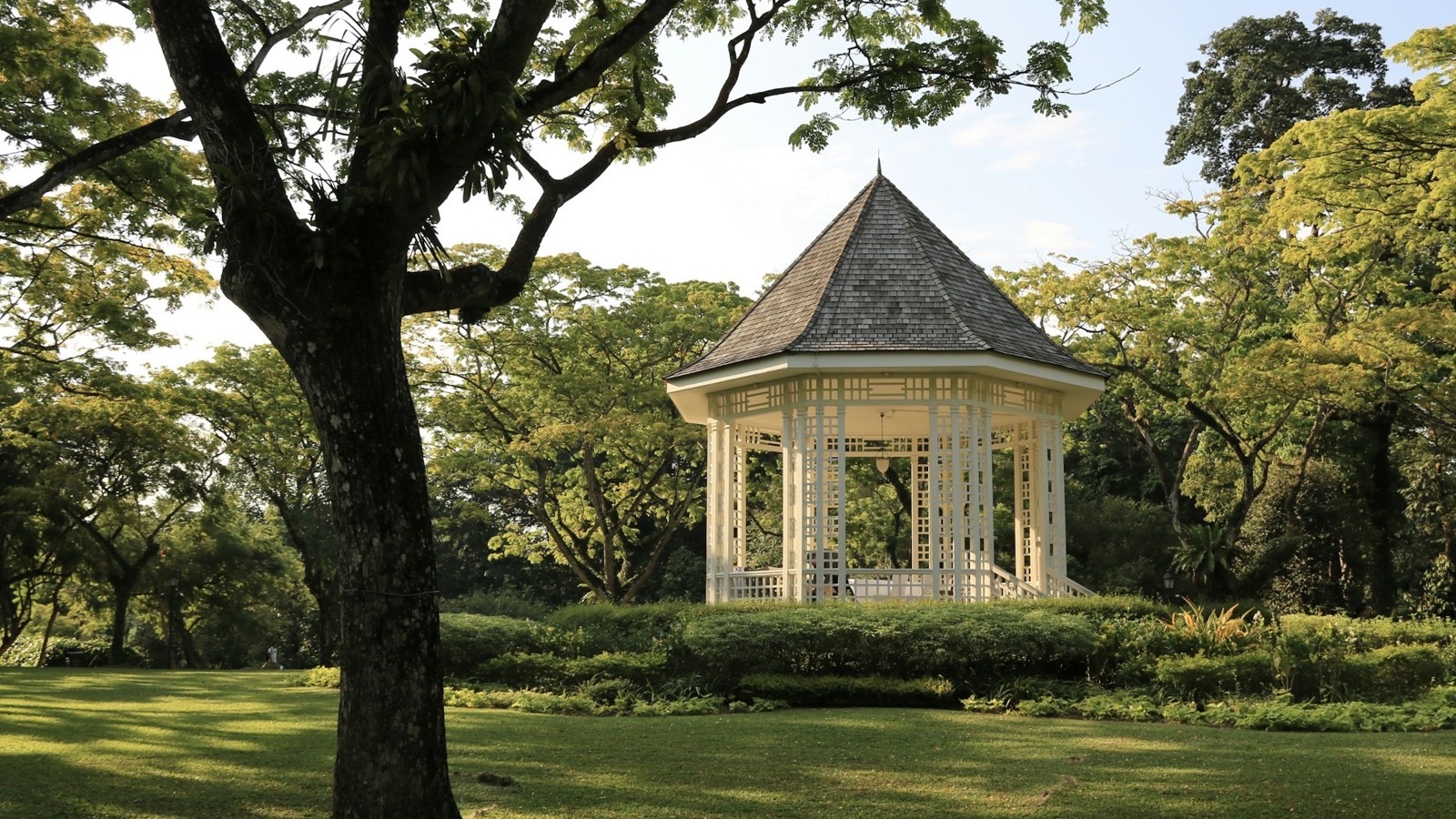
Gardens by the Bay’s Flower Dome and Cloud Forest ticket costs S$46 per adult for visitors and S$34 for Singapore residents, GST included, for a visit of about two hours. The Singapore Botanic Gardens, a UNESCO World Heritage Site since 2015, is free and open from 5am to midnight. That makes it the easy choice for an early walk before a day of sessions.
Hotel rates for your dates come from quotes. As a ceiling, the US State Department’s foreign per diem rates for Singapore, effective 1 January 2026, are $302 a night for lodging all year and $162 a day for meals and incidental expenses. Amsterdam’s are $433 and $183, as its profile shows, and Barcelona’s $293 and $128. Those are federal reimbursement limits, not hotel quotes, but they put a Singapore room closer to Barcelona than to Amsterdam.
Prices in Singapore carry GST (goods and services tax), at 9% according to IRAS, the tax authority. Check whether each hotel and venue quote includes it before comparing them with cities that quote tax separately.
Comparing Singapore with other cities
The offsite destination comparison template has the rows to score Singapore against two to four other cities, and the budget breakdown by flight access shows what changes when an office has to connect. For a team mostly in the US, the international offsites guide covers the cities with more US nonstops. The Amsterdam, Lisbon and Barcelona profiles cover European options, and the cluster page has the full method, from team roster to shortlist.
Open Midway with your offices’ airports to see whether Singapore is on the shared list in the month you plan to travel. It takes up to six departure airports and shows routes and flight times, not venue availability or hotel prices.