
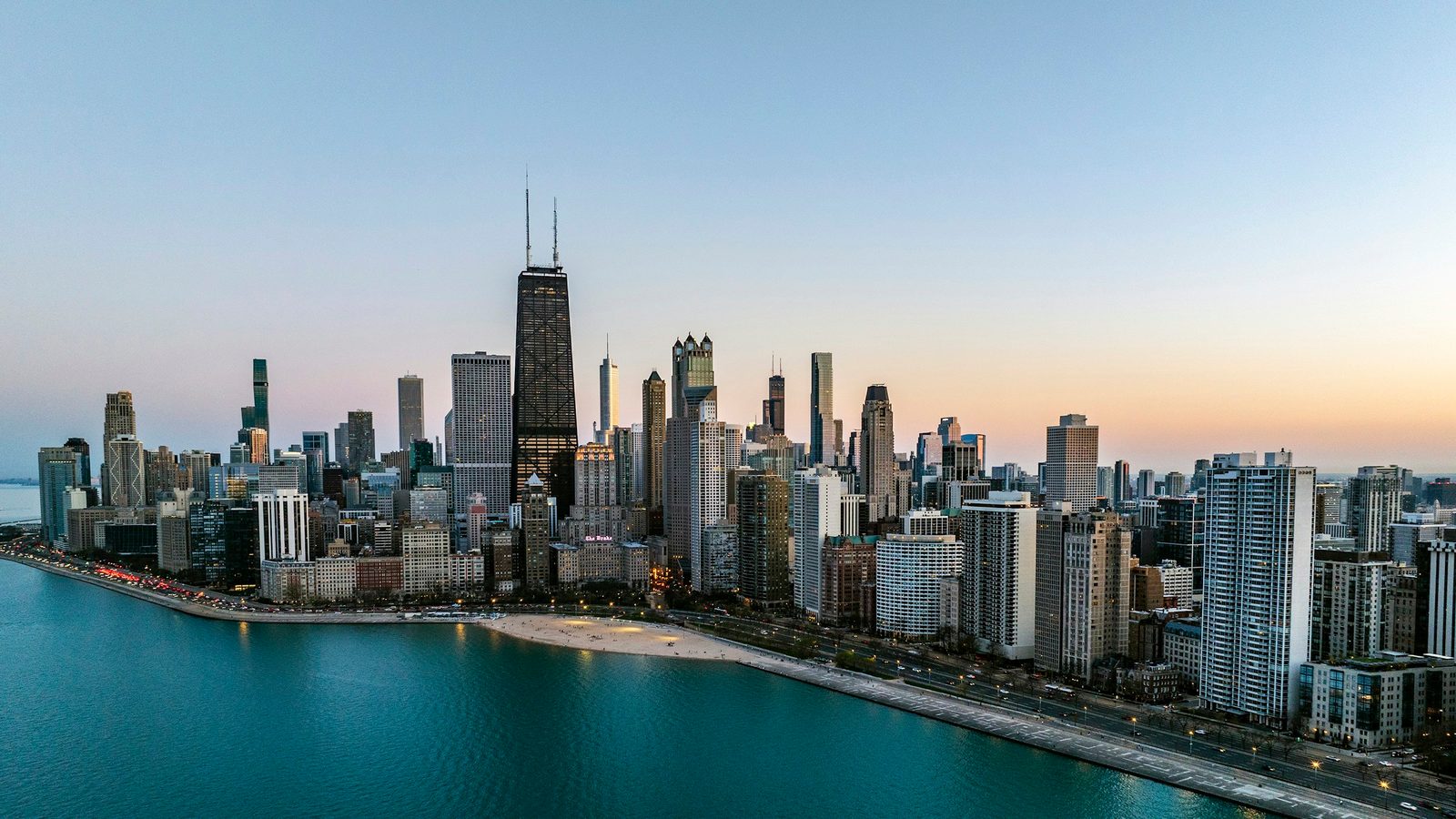
Two airports serve Chicago, and both work as connecting hubs. O’Hare runs around 275 nonstop destinations on its own, and Midway adds around 90 on a Southwest network that only partly overlaps with it. Four mainline carriers run heavy schedules, and the city still shows up in nearly every group’s overlap.
Chicago is what people picture when they hear “meet in the middle”: 90 minutes from the East Coast, four hours from the West, and Southwest, United, American, Delta, Frontier, and JetBlue all running competitive schedules.
Two airports, one meeting city
O’Hare (ORD) is United’s largest hub and American’s third. It handles most international service (Asia, Europe, Latin America in volume) and the deepest domestic schedule outside the Sun Belt hubs. Midway (MDW) is the heart of Southwest’s system. The two airports don’t serve the same network, and that matters when you’re planning for a group.
If anyone in your group is loyal to Southwest, default to Midway. Southwest’s nonstops from places like Albany, Manchester, or Tucson land at MDW, not ORD. United and American flyers will always be looking at O’Hare. For most groups planning a one-time trip rather than optimizing miles, the practical question is which airport has more direct flights from everyone’s home cities. Midway shows the smaller list, O’Hare the larger one.
Combined, the two airports connect to around 285 destinations, which keeps Chicago in the overlap for groups that include the West Coast, the Northeast, the South, and parts of Canada.
Check which Chicago airport works for your group. Enter departure cities and Midway pulls the nonstop overlap.
What to do once you’re there
A group can spend a long weekend walking from Millennium Park down to the Riverwalk to the Art Institute without needing a rideshare, with the lakefront alongside the whole way.
The West Loop is where the food energy concentrated. Randolph Street’s restaurant row runs from approachable neighborhood spots to the kind of places with month-out reservation policies. Wicker Park and Logan Square are the indie alternatives: bookshops, dive bars, cheaper food, harder to get to by public transit but worth the trip.
Lincoln Park and Wrigleyville are the obvious picks for friend groups oriented around bars and a Cubs game. Pilsen is the local-favorite alternative: Mexican food, murals, and a less polished energy than the North Side. Hyde Park is a half-day on its own: Museum of Science and Industry, the Obama Presidential Center construction site, and the University of Chicago campus.
Pizza: Lou Malnati’s for deep dish, Pequod’s for the caramelized crust, Pizzeria Lombardo’s by the slice, and a dozen more arguments about which version is real. Italian beef is the other local order.
Say your group is split between Los Angeles, New York, and Dallas. Chicago lands in the overlap, along with a handful of other hubs:
See also: Raleigh-Chicago meeting points, or browse the full city-pair meeting points hub for every pair.
Budget and logistics
Chicago hotels run mid-pack for a major city: meaningfully cheaper than New York or San Francisco, slightly above Atlanta or Charlotte. Expect $180-280/night for a solid downtown room outside of major convention weeks. Loop and River North are the convenient base for first-time groups. West Loop hotels put you in the food district. South Loop is the budget alternative with easy lakefront access.
Getting from the airports: O’Hare to downtown is 45 minutes on the Blue Line for $5, or 30-60 minutes or more by rideshare depending on traffic ($50-70 typical). Midway to downtown is faster: 30 minutes on the Orange Line, also $5, and the rideshare math works out cheaper too ($30-45). For most groups, the L is the right call from both airports.
Flight times from major cities:
| From | Flight time |
|---|---|
| New York (JFK) | 2.5 hours |
| Los Angeles (LAX) | 4 hours |
| Dallas (DFW) | 2.5 hours |
| Denver (DEN) | 2.5 hours |
| Atlanta (ATL) | 2 hours |
Best seasons: May through October. June and September are the sweet spot. July and August can hit the 90s with high humidity but the lakefront stays bearable. Winter is the trade-off: January and February regularly drop below 20F with heavy wind chill, and group travel in those months gets harder. Spring is short and unpredictable.
Plan a Chicago trip with Midway.
Who meets in Chicago
Family reunions. Walkable downtown, large museums, lakefront for kids, and direct flights from essentially every city east of the Rockies. The cost-to-quality ratio undercuts New York or Boston for the same kind of urban family trip. See our family reunion destination guide for how Chicago compares against other hubs.
Corporate offsites. Chicago has the convention infrastructure of a top-three US business city: every major hotel chain has a downtown property built for groups, and McCormick Place sits a short drive south. For distributed teams with members on both coasts, Chicago consistently lands in the middle on both flight time and ticket cost.
Friend trips. Bar density, comedy clubs (Second City, iO Theater), live music year-round, and the kind of restaurant scene that gives a group a different cuisine every night for a week. Bachelor and bachelorette parties pick Chicago more often than the Nashville stereotype suggests; it ranks competitively in our best bachelorette cities guide.
Conference convergence. If half your team is already in Chicago for a conference, extending into an offsite or team dinner is simple. The city absorbs business travel volume without strain.
The open question is the airport. Southwest flyers are looking at MDW, United and American flyers at ORD, and the two networks only partly overlap, so run the search from each if the group is split across carriers.