
Schiphol reaches around 275 nonstop destinations across 86 countries, all from one terminal complex, in a country of about 18 million people. For comparison, the New York metro (three airports, twenty million people) reaches around 275. Amsterdam does nearly the same from one airport.
For anyone planning a group trip across several countries, organising a family reunion or scoping a distributed-team offsite, that makes Amsterdam one of the simpler meeting points in Europe: one airport, one train, no cross-city transfer.
Schiphol’s single-airport network
KLM built Schiphol into a hub for a market far too small to justify it, on the theory that transfer passengers would make up the difference. It worked. Schiphol became the connecting point between Northern Europe and everywhere else, and the route map still reflects that: dense coverage of every mid-sized European city, plus a long-haul network across North America, Asia, Africa and the Caribbean that is out of proportion to a country of 18 million.
Amsterdam has one of the strongest single-airport networks in Europe; only Istanbul, Frankfurt and Paris Charles de Gaulle reach more from a single airport. London reaches more destinations in total, around 420, but assembles that number across Heathrow, Gatwick, Stansted, Luton and City, five airports as much as 90 minutes apart. Paris pulls further ahead once Orly is added to Charles de Gaulle.
Schiphol’s route count is more exposed to policy than most European hubs, which is worth knowing if you’re planning something a year out. The Dutch government spent several years trying to cap Schiphol at 478,000 annual movements on noise grounds, a plan KLM called incomprehensible. The Council of State annulled it in March 2026, so the overall cap is gone, but a limit of 27,000 night movements survived and the political pressure behind the original proposal has not.
The practical consequence for a group is that Amsterdam removes a class of problem rather than solving it. There is no airport to choose, no risk of one person booking into the wrong one, and no cross-city transfer if plans change. Everyone lands in the same terminal complex.
Check Amsterdam nonstops for your group. Enter everyone’s departure cities and Midway returns the overlap.
What to do once you’re there
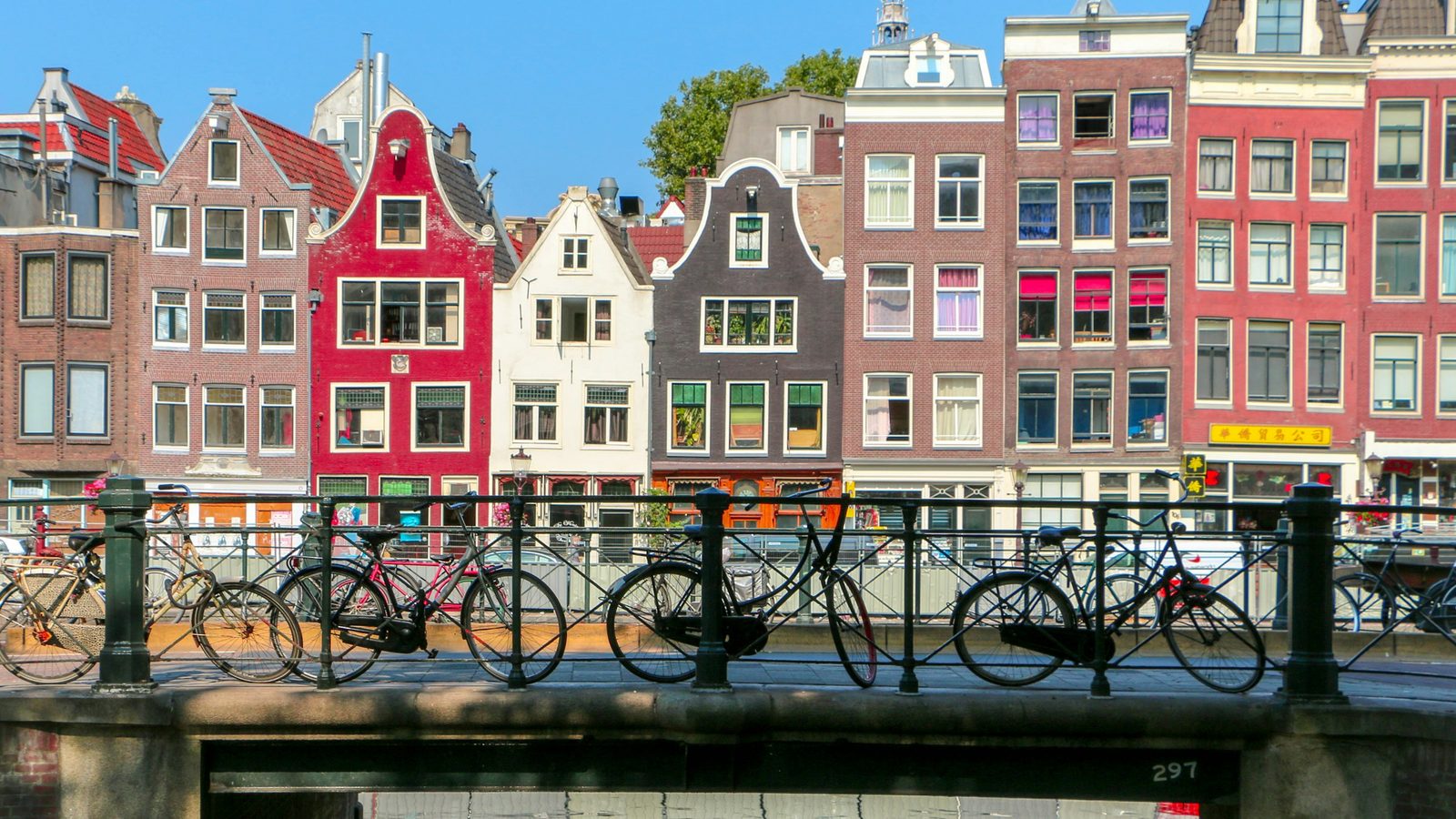
The canal ring is the usual first stop. It’s a UNESCO site, it’s walkable end to end, and it works as an activity in itself for a group that hasn’t agreed on anything else yet.
Jordaan is the neighbourhood most groups settle in: narrow streets, small restaurants, and enough bars that an evening plans itself, without the crowd density of the centre.
De Pijp is where to stay if the budget matters. South of the centre, well connected by tram, cheaper on accommodation, and home to the Albert Cuyp market.
The museums cluster. The Rijksmuseum, Van Gogh Museum and Stedelijk sit around the same square, which means a group can split by interest in the morning and reconvene for lunch without anyone crossing the city.
Bikes are the local answer and a poor group answer. Amsterdam cycling works for residents and is unforgiving of tourists who haven’t done it before. For a group of eight with mixed confidence, trams and walking cause fewer problems.
Take a group flying from London, Madrid and Stockholm. Amsterdam sits in the overlap, along with a set of other options:
See also: where to meet between the US and Europe if part of the group is transatlantic, or the intercontinental meeting points cluster for wider splits.
Budget and logistics
Amsterdam is no longer a cheap weekend, and that is deliberate policy rather than market drift. The city has spent several years discouraging high-volume party tourism and raising the cost of visiting: the tourist tax on accommodation is already the highest in Europe and is scheduled to keep climbing over the rest of the decade. Mid-range hotels run €160–260 a night in shoulder season and considerably more in summer.
Ground transport is the compensation. Getting from the airport: the NS train station sits directly underneath the terminal (down an escalator from arrivals, no shuttle, no separate airport line) and reaches Amsterdam Centraal in about 15 to 17 minutes, roughly eight times an hour. Few major airports have a rail station this close to arrivals, and for a group arriving on six different flights it removes most of the coordination burden.
Flight times from major cities:
| From | Flight time |
|---|---|
| New York (JFK) | 7.5 hours |
| London (LHR) | 1.5 hours |
| Madrid (MAD) | 2.5 hours |
| Rome (FCO) | 2.5 hours |
| Stockholm (ARN) | 2 hours |
Best seasons: April to June and September. Spring gets the long daylight and the tulip season without July’s crowds or prices; September holds the weather and drops the rates. Winter is cheap, dark and wet, but Schiphol’s network barely contracts, so it stays easy to reach.
Plan an Amsterdam trip with Midway to see what works for your group.
Who meets in Amsterdam
Distributed team offsites. Amsterdam is a reasonable default for a European or transatlantic team. Nonstops from most US hubs and every European capital, a compact city where the venue and the hotel are usually walking distance apart, and English spoken universally in a business context. Ground costs run below London’s for comparable quality.
Transatlantic family gatherings. The airport-to-centre train does a lot of work when grandparents and small children are involved, and the city is flat, compact and heavily pedestrianised. Direct service from a dozen US cities makes the American side of the trip straightforward.
Friend trips. Still workable, with one caveat: Amsterdam has actively discouraged the stag-and-hen market, and the city is less welcoming to large groups whose plan is drinking than it was a decade ago. Groups whose weekend is built around that will find better value and a warmer reception elsewhere in Europe.
Corporate meetings with an Asian or African leg. KLM’s network reaches places most European carriers don’t, which matters when the attendee list runs beyond Europe and North America.
Amsterdam rarely wins on price. What it removes is the airport decision: when a group arrives from six cities on six schedules, everyone lands in the same terminal and takes the same train. The search covers nonstop access into Schiphol, not hotel rates, which is where Amsterdam is the expensive option.